
Cliff’s Story
That Unforgettable Card Game
We were enjoying a friendly game of cards when I played what I thought was a winning running flush — until I was rudely and embarrassingly forced to take back my play because there were four clubs and one spade.
The reaction was swift: I was treated as if I were a fool, and an incompetent one at that.
Later, I realised that people saw me not as someone who simply couldn’t see well, but as someone less intelligent. I was furious with myself — because in that moment, it felt true.
I couldn’t read anymore. Emails, newspapers, professional journals, management reviews, even legal documents — all out of reach. At a stroke. All gone.
Making Life Easier
My background as a management consultant came to my aid.
What, why, when, where, and how. The greatest of these is why.
Examine everything you do, one thing at a time.
Buy waterproof shoes so you can scrub them clean — that’s better.
Find the safest route to the shops — that’s better.
Report overhanging bushes and hedges — that’s better.
Get short drinking glasses so you don’t knock them over — that’s better.
Choose white, yellow, or red flowers — easier to see. That’s better.
Mark key items with bright orange tape — that’s better.
Start with one step, then take the next. Do that enough times, and you survive.
So that’s better.
Using a white stick is difficult at first — you feel self-conscious and awkward. Eventually, though, you get used to it and appreciate the benefits. My preferred one is telescopic rather than folding.
So that’s better.
Getting the Brain Working Again
Maybe I can’t read, but I can listen — and I’ve had hearing aids for forty years! Fortunately, I’ve always been an early adopter of new technologies — one of those people willing to try something new, even if it sometimes turns out to be a waste of time and money.
I had an early Google Motorola smartphone, and with its Select to Speak function, I was back to “reading” my emails — by listening. Admittedly, listening takes seven times longer than reading, but you adapt. A law professor in Australia has learned to listen at sixteen times normal speed; I’m at 1.2!
Eventually, I upgraded to a Google Pixel (did you know Google bought Motorola to settle an intellectual property dispute, then sold Motorola but kept the staff to build the Pixel?).
So that’s better.
With that, I could subscribe to newspapers, shop online, manage my bank, and listen to books on Audible.
Now that’s better.
The brain was working again — I could join in conversations. And with top-quality hearing aids, I could finally hear them properly.
Now that’s better.
Recovering My Self-Confidence
The next step was getting out and about. I joined the Macular Society as a volunteer, attended training courses, and went to conferences in York and London — using my Disabled Person’s Railcard to save a third on travel.
Then I decided I had to see Snowdon again while I still could. I went on my own. It took planning and careful thinking about every step. I memorised the map, escape routes, and landmarks, and took my camera to prove it. I did it — and my confidence soared.
Now that’s better.
Learning to read again meant using smartphone tools: saving pages to revisit quickly, using triple-tap to zoom into words, and pinching to enlarge pictures.
Now that’s better.
Over time, I noticed that I could see faintly out of the corner of my left eye. I practised daily, training my vision to move the image towards the centre. After months, my right eye joined in. It was blurry, but it worked — both eyes overlapping.
That’s better again.
Seeing Things Differently
Back in my management consultancy days, I learned the value of looking at things from a different angle — a side view. I remember redesigning a company’s entire production and distribution system, only for their new tax-free Grecian-style dress to throw everything into chaos! But the system survived — and sales doubled, then redoubled.
It taught me: adapt, adjust, and always look for “better”.
Life’s Easier with a Smartphone
Life really is easier with a smartphone (see my detailed checklist elsewhere).
Recently, after much persuasion from my carers, I gave up wine — completely. The racks are now stored under the stairs, out of sight, out of mind.
I’m amazed: my brain is sharper, my memory deeper, my peripheral vision clearer, colours brighter.
Now that’s better.
Learning What Works (and What Doesn’t)
Not everything went smoothly. Some experiments failed, others stuck.
Take tennis, for example. I used to be good — decades ago — until my eyesight meant I couldn’t track the ball in time. My racket stayed in its press for forty years. But I found joy again playing Snap with my grandchildren.
Still, the loss of reading left me frustrated. I had been a successful management consultant and salesman, and now I couldn’t even play cards properly.
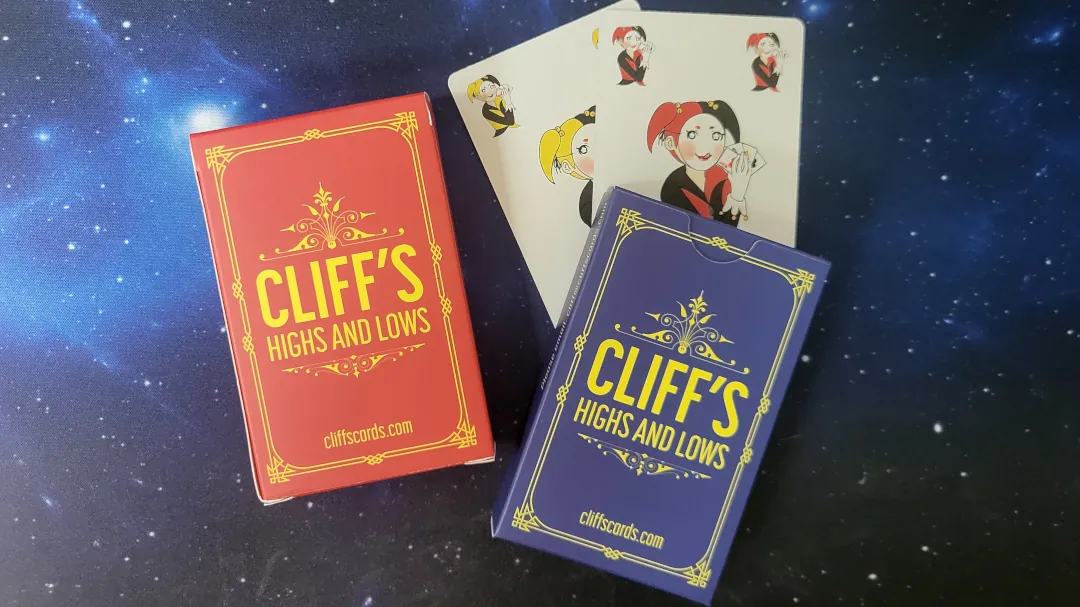
I tried several large-print decks — none were good enough. So I decided to create my own.
Creating Cliff’s Cards
I found a printer and persuaded him to develop something new — “on the hoof”, through trial and error. Over several years, and with frequent injections of cash, we refined the design together.
Then COVID struck. Everything stopped. The business folded, people lost their jobs, and I was left only with a PDF of our Joker.
Thankfully, I had my allotment. We raised the beds higher to make them easier to see, even if the paths weren’t straight and the rows wiggled. Still, the plants grew — so that’s better.
I bought new tools, lightweight drills, and special screws that didn’t need pilot holes.
Now that’s better — really better.
I can’t read small print, but I can read large Scrabble tiles and Mahjongg pieces. And now, thanks to my cards, I can play with my grandchildren again — though they’ve outgrown Snap!
The Classic, Modern, and Trump Decks
With improved finances, I found a specialist printer. We realised that to make the numbers truly legible, the cards needed to be taller.
We designed the Classic deck first, then a shorter Modern version (126mm instead of 156mm), and finally the Trump at 100mm — still larger than a standard 96mm card.
We also improved suit visibility: spades have yellow centres and diamonds white.
After a feature in the Macular Society’s Sideview magazine, dozens of people have been able to “get their hands on a set” and rediscover the joy of playing cards.
Now that’s better.
And I’ve had several games with my grandchildren — that’s truly better.
Keep Creating Positive Activities
For many years, sailing was my passion. Once, as a tactician, I helped a crew finish forty minutes ahead of the next boat after twelve hours at sea.
I tried sailing again, but without depth perception, judging distances was impossible. I decided that getting cold and wet was best left to younger sailors. Hey ho — time to change tack!
When COVID finally eased, I returned to the allotment — always chasing better flavour, earlier crops, later harvests.
Always Take a Camera
A friend from the RNIB taught me one golden rule: “Always take a camera.”
Later, you can enjoy your memories on a large TV via Chromecast.
I now collect images to accompany my music playlists — thousands of tracks from Stravinsky and Paganini to Elvis and Neil Diamond, all organised in the Pi Music Player app.
Hearing Music Again
My new hearing aids are extraordinary. I’m hearing sounds I haven’t heard for forty, maybe sixty, years — discovering composers like Sarasate, Paganini, Vivaldi, and Beethoven anew, and virtuosos like Itzhak Perlman, Yuja Wang, Alice Sara Ott, Lang Lang, Vanessa-Mae, and Joby Talbot.
My key interests now are family, friends, Cliff’s Cards, our allotment, the U3A Classical Music and Gardening Groups, staying healthy, and playing Scrabble.
Looking Ahead
As an early adopter, I’m excited by the future — smart glasses, brain-linked devices, self-driving cars, even ESP.
For the future:
- Cliff’s Cards will continue — slowly or quickly.
- The Spades symbol may take on a life of its own.
- Beautiful Summer’s Day stories will continue.
- And always — a game of cards!